
Wastewater or Waste Water is something many people encounter every day when they turn on taps, flush toilets, wash clothes, or cook meals — yet few ever seriously consider where this ‘used water’ ultimately goes or what journey it takes. Although it may sound technical and distant, wastewater quietly impacts urban rivers, water security, and even public health.
Preferred Spelling: Wastewater (Compound Word)
In professional, academic, and official contexts, “Wastewater” (as a single word) is the standard spelling.
- Industry standards: The U.S. Environmental Protection Agency (EPA), World Health Organization (WHO), and major academic journals (such as Water Research) almost uniformly use the single-word form.
- Dictionary definitions: Major dictionaries like Merriam-Webster and Oxford list it as a single noun.
Common Spelling: Waste Water (Two-Word Form)
Waste water is commonly used in informal writing or as the standard spelling in certain regions, but is gradually being replaced by the compound form in professional literature.
- Common usage: Some UK or Irish government agencies (e.g., EPA Ireland) occasionally retain the two-word form.
- Semantic distinction: When used as a verb phrase, it must remain separate. For example: “Don’t waste water.”
What is Wastewater?
Regardless of spelling, the core meaning refers to water whose quality has been compromised by human activities such as industrial, commercial, or domestic use.
- Composition: Typically consists of 99.9% water and 0.1% suspended solids, pathogens, and chemicals.
- Classification:
- Sewage: Wastewater originating from toilets, kitchens, and bathrooms.
- Industrial Wastewater: Effluent from manufacturing processes.
- Runoff: Water entering drainage systems after rainwater washes over streets.
Recommendation: When writing formal reports, scientific articles, or business documents, use “wastewater.” Use “waste water” only when referring to the act of wasting water.
Why Must Wastewater Be Treated?
Environmental Impact
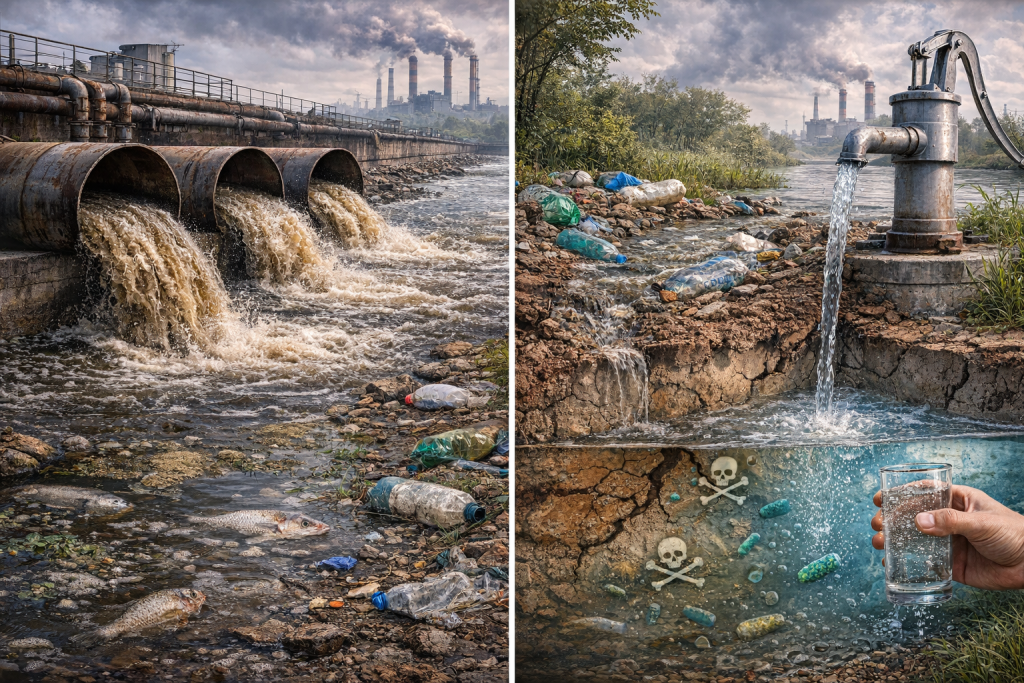
- Damage to river, lake, and marine ecosystems (reduced dissolved oxygen, fish mortality, algal blooms, etc.).
- Threats to groundwater and drinking water safety.
Human Health and Societal Impact
- Hazards to human health from pathogens, heavy metals, and organic pollutants.
- The critical importance of wastewater management in the context of urban development, water security, and climate change.
Key Stages of Wastewater Treatment
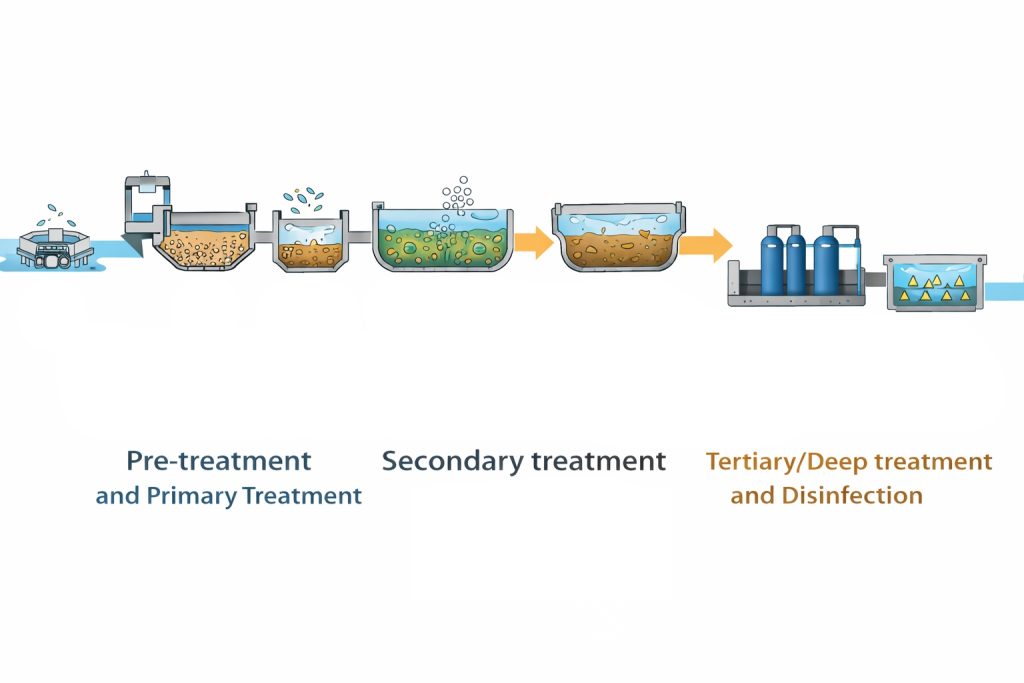
Pretreatment and Primary Treatment (Physical Removal)
- Pre-treatment: Screens, grit chambers—removes large particles, sand, and floating debris.
- Primary Treatment: Sedimentation tanks, primary settling—removes suspended solids and some organic matter.
- Purpose: Reduces load on subsequent biological systems and enhances overall stability.
Secondary Treatment (Biological Treatment as Core)
- Principle: Utilizes microorganisms to decompose organic matter and remove nutrients such as nitrogen and phosphorus. Typical examples include the activated sludge process and oxidation ditch systems.
- Process Key Points: Aerobic/anoxic conditions, sludge return, control of sludge age and dissolved oxygen levels.
- Effect: Typically removes the vast majority of BOD/COD and suspended solids, laying the foundation for compliant discharge or advanced treatment.
Tertiary/Advanced Treatment and Disinfection
- Advanced Treatment Units: Sand filtration, membrane filtration (ultrafiltration/reverse osmosis), activated carbon adsorption, chemical oxidation, etc., used to remove residual suspended solids, color, trace organic pollutants, and nutrients.
- Disinfection: Chlorine disinfection, ozone, UV, etc., used to eliminate pathogens and ensure safe effluent quality.
- Applicable Scenarios: Reclaimed water reuse, discharge into environmentally sensitive water bodies, upstream of drinking water sources, etc.
Sustainable Wastewater Management and Reuse
- Reclaimed Water and Reuse: Applications of reclaimed water in agricultural irrigation, municipal landscaping, industrial cooling, and toilet flushing. The trend toward “wastewater resource recovery” in water-scarce regions.
- Resource Recovery and Energy Utilization: Recovering biogas through anaerobic digestion for energy supply, reducing carbon emissions and operational costs. Recycling nutrients like nitrogen and phosphorus for fertilizer production or chemical feedstock.
- Green and Smart Technologies: Utilizing solar energy and photovoltaic systems to reduce energy consumption. Employing high-efficiency membrane technology, intelligent monitoring, and automated control to achieve “lower energy consumption + higher effluent quality.”
Monitoring and Control in Wastewater Systems
Accurate monitoring is critical to efficient wastewater treatment. Online measurement of parameters such as pH, dissolved oxygen, turbidity, and sludge level helps operators maintain stable process conditions and optimize performance. Real-time data also supports regulatory compliance and reduces operational risks.
Summary
Wastewater may seem unremarkable, yet it connects to a series of critical issues including environmental health, urban development, and water resource security. From physical pretreatment and biological secondary treatment to advanced purification and reuse, each processing step contributes to both “reducing the burden” and “adding value” to the water cycle. As technology advances, everyday choices—such as reducing household chemical and pollutant discharges, and supporting reclaimed water and green infrastructure—can also align individual actions with sustainable wastewater management. If you have any requirements in water treatment or wastewater management, please feel free to contact us.