
What is Zero Liquid Discharge?
Zero Liquid Discharge (ZLD) is a high-standard objective and systematic solution for industrial wastewater treatment and water resource reuse.
Deconstructing the Core Meaning of ZLD
Zero: No liquid wastewater discharge permitted.
Liquid: No discharge permitted, including treated wastewater.
Discharge: No discharge into rivers, groundwater, or municipal sewer systems.
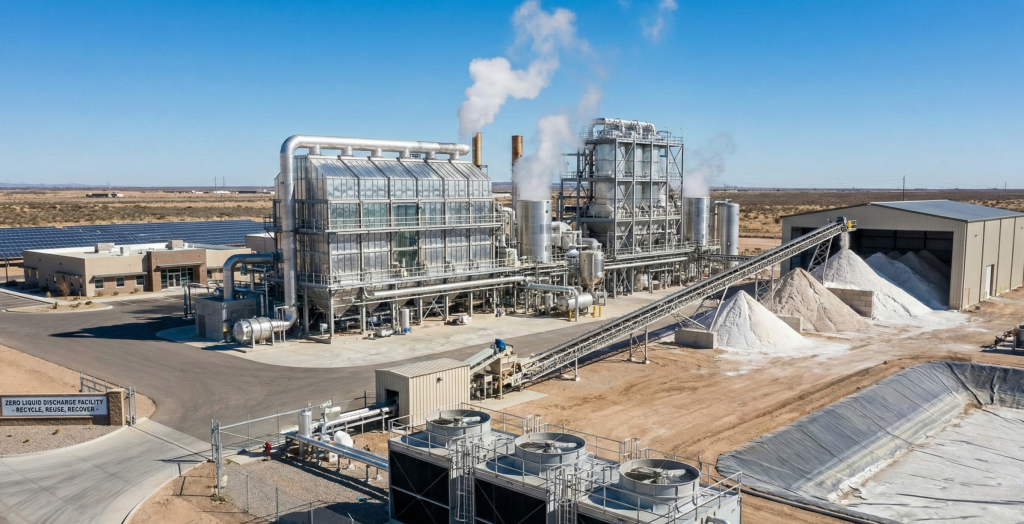
The Fundamental Difference between ZLD and Conventional Wastewater Treatment
| Parameter | Traditional Treatment | Zero Liquid Discharge (ZLD) |
|---|---|---|
| Treatment Objective | Compliance with discharge regulations | Complete elimination of liquid discharge |
| Final Products | Treated wastewater | Reclaimed water and solid salts |
| Effluent Discharge | Allowed | Not allowed |
| System Complexity | Moderate | Extremely high |
| Capital & Operating Cost | Relatively low to medium | High |
Table of ZLD
Why are More and More Industries Having to Consider ZLD?
In the past, meeting discharge standards was the primary goal of industrial wastewater treatment. However, with increasing water resource pressures and evolving environmental regulations, “discharge” is shifting from an option to a constraint. More and more industries are beginning to view Zero Liquid Discharge (ZLD) as an inevitable choice for long-term sustainable development.
Environmental regulations continue to tighten, leaving less room for emissions.
- In recent years, numerous countries and regions worldwide have continuously tightened industrial wastewater discharge standards, particularly for:
- High-salinity wastewater
- High TDS wastewater
- Wastewater containing heavy metals and refractory pollutants
2. Resource scarcity intensifies, significantly boosting reuse value.
The cost of producing industrial water for hydration continues to rise:
- Arid regions
- Coastal areas
- High-water-consumption industries
ZLD systems maximize:
- Process water reuse
- Cooling water reuse
High-Salinity, High-Concentration Wastewater has Become Difficult to Discharge Conventionally.
In industries such as chemical processing, power generation, textile dyeing, and pharmaceutical manufacturing, large volumes of wastewater exhibit:
- High TDS
- High chloride ion content
- High sulfate content
- High COD
Typical Process Flow for ZLD Systems
Zero Liquid Discharge is not a single technology but a multi-unit integrated system engineering solution. Depending on wastewater quality, quantity, and reuse objectives, ZLD systems typically employ a multi-stage treatment pathway centered on membrane concentration + evaporation crystallization to maximize water resource reuse and achieve final salt solidification.
- Classic Process Route: Membrane + Evaporation + Crystallization
Pre-treatment → UF/NF/RO → Concentrate → MVR/Multi-Effect Evaporation → Crystallization → Salt Solid Transportation or Recovery
Technical Features:
- The membrane system significantly reduces the water volume entering the evaporation system.
- Evaporation crystallization serves as the terminal unit, achieving true zero discharge.
- All effluent is reused, while salts are discharged in solid form.
Applicable Scenarios:
- High-salinity, high-TDS industrial wastewater.
- Projects requiring strict zero discharge in industries such as chemical, power generation, textile dyeing, and pharmaceuticals.
- Energy-Efficient Process Route: Multi-Stage Membrane Concentration + Low-Load Evaporation
Pre-treatment → High-Recovery RO / DTRO → Multi-Stage Concentration → Small-Scale Evaporation → Crystallization
Applicable Scenarios:
- High water volume, medium to high salinity.
- Projects sensitive to operating costs.
Advantages:
- Significantly reduces evaporation load.
- Operating costs are substantially lower than traditional ZLD systems.
- Offers superior economic performance.
3. High Organic Matter Route: Biochemical + Membrane + Evaporation Crystallization (Specialized for High COD Wastewater)
Processing → Anaerobic / Aerobic → UF / RO → Concentrate → Evaporation → Crystallization
Technical Features:
- First, significantly reduce COD through a biochemical system.
- Then proceed to the membrane filtration and evaporation system, preventing organic contamination of the evaporation equipment.
Applicable Scenarios:
- Pharmaceutical, pesticide, food, and fermentation industries
- High COD + high-salinity composite wastewater
Advantages:
- Reduce the risk of contamination in evaporation systems.
- Enhance long-term system stability.
Salt Separation Resource Recovery Process: Salt Separation Crystallization + Recycling
Pre-treatment → Membrane concentration → Salt separation evaporation crystallization → Separate recovery of different salt types
Technical Features:
Separates salts such as NaCl and Na₂SO₄ based on solubility differences
By-product salts can be reused as industrial Raw Materials
What is The Biggest Challenge with ZLD?
Although Zero Liquid Discharge is considered the ultimate solution for industrial wastewater treatment, the greatest challenges faced by ZLD in practical engineering primarily revolve around three aspects: cost, energy consumption, and system stability.
First, investment and operating costs are high. ZLD systems typically require multi-stage membrane systems, evaporators, and crystallization equipment, entailing significant initial investment. Simultaneously, the evaporation process consumes extremely high levels of energy, making long-term operating expenses the most direct economic burden for enterprises.
Second, system complexity makes stable operation difficult. ZLD systems consist of highly coupled units, where fluctuations in any component can disrupt continuous operation, demanding exceptional design and operational expertise.
Third, scaling, corrosion, and membrane fouling are prominent issues. High-salinity wastewater readily causes equipment scaling and corrosion while accelerating membrane fouling. Without adequate pretreatment and scale control, system performance can deteriorate significantly within a short timeframe.
Finally, the ultimate disposal of salts remains a challenge. The substantial solid salts generated by ZLD require safe disposal or resource recovery; otherwise, they introduce additional costs and environmental risks.
Conclusion
If your project faces high salinity, high TDS, or stringent zero discharge requirements, selecting the appropriate ZLD solution is critical.
Our engineering team possesses extensive experience in designing and implementing ZLD systems, offering you a one-stop solution from water quality analysis and process design to equipment selection and system integration. Contact us to collaborate on building a stable, efficient, and sustainable zero discharge water treatment system.