
Cooling Water Treatment refers to the chemical and physical management of industrial cooling water systems (such as cooling towers, closed-loop systems, and HVAC cooling systems) to maintain stable water quality, prevent corrosion, scaling, and biological fouling, improve heat transfer efficiency, and extend equipment service life.
Why Cooling Water Treatment Is Necessary
In industrial systems, cooling water continuously circulates and evaporates. This causes dissolved minerals and contaminants to concentrate, leading to:
- Scaling – Calcium carbonate, magnesium salts forming hard deposits
- Corrosion – Metal degradation due to oxygen, pH imbalance, or aggressive ions
- Biofouling – Growth of bacteria, algae, and biofilm (including Legionella risk)
- Suspended solids buildup – Dirt and debris reducing heat exchange efficiency
Without proper treatment, systems experience:
- Higher energy consumption
- Equipment failure
- Unplanned downtime
- Increased maintenance cost
Types of Cooling Water Systems
Open Recirculating Systems
- Description: Water is circulated through a cooling tower and cooled by evaporation.
- Advantages: Water-efficient compared to once-through systems.
- Disadvantages: Higher risks of scaling, corrosion, and biological growth due to evaporation concentration.
Closed Loop Systems
- Description: Water circulates in sealed pipes and heat exchangers without direct contact with air.
- Advantages: Minimal contamination, lower scaling and corrosion risk.
- Disadvantages: Higher initial investment and need for corrosion protection and freeze prevention.
Once-Through Systems
- Description: Fresh water is used once for cooling and then discharged.
- Advantages: Simple operation with minimal water treatment.
- Disadvantages: High water consumption and environmental impact.
Hybrid Systems
- Description: Combine features of open recirculating and closed-loop systems to reduce water consumption while minimizing contamination risks.
Common Treatment Methods
| Category | Method | Description |
| Physical Treatment | Filtration, sedimentation, ultrafiltration, ion exchange | Removes suspended solids and partial hardness |
| Chemical Treatment | Scale inhibitors, corrosion inhibitors, biocides | Prevents scaling, corrosion, and microbial growth |
| Operational Control | Blowdown control, cycles of concentration, online monitoring | Maintains stable water quality |
Key Control Parameters
- pH: Typically maintained between 7.0 and 9.0
- Total Hardness (Ca²⁺ + Mg²⁺): Controlled to prevent scaling
- Cycles of Concentration: Regulated through blowdown to limit salt buildup
- Microbiological Indicators: Total bacterial count, corrosion rate
- Conductivity / TDS: Controls total dissolved solids
Important Considerations
- Regularly monitor water quality and adjust chemical dosage accordingly
- Design systems to allow easy blowdown and cleaning
- Use environmentally friendly chemicals to avoid secondary pollution
- Avoid excessively high water temperatures, which accelerate corrosion and microbial growth
Cycles of Concentration (COC)
Cycles of Concentration refers to the ratio of dissolved solids in circulating water compared to makeup water.

Higher COC reduces water consumption but increases scaling and corrosion risk. Most industrial cooling towers operate between 3–7 cycles, depending on water quality and treatment program.
Proper COC optimization helps:
- Reduce blowdown volume
- Save water cost
- Improve chemical efficiency
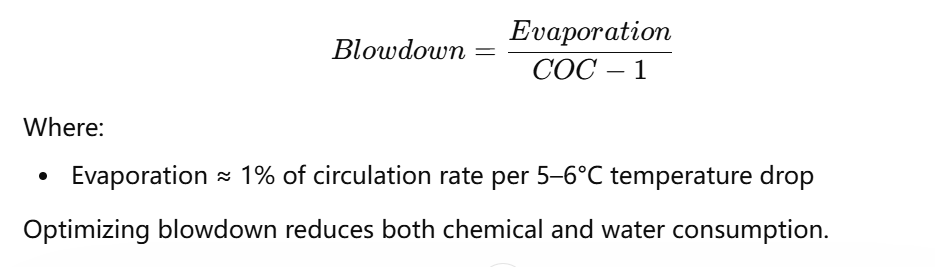
Blowdown Calculation Example
Blowdown is required to control TDS accumulation.
Common Failure Cases in Cooling Systems
Rapid Heat Exchanger Fouling
Cause:
- High suspended solids
- Biological slime formation
Impact:
- Reduced heat transfer efficiency
- Increased energy cost
Solution:
- Side-stream filtration
- Biocide shock dosing
- Regular inspection
Under-Deposit Corrosion
Cause:
- Deposits trapping oxygen and aggressive ions
Impact:
- Localized pitting
- Premature equipment failure
Solution:
- Proper filtration
- Dispersant use
- Corrosion monitoring probes
Legionella Risk Management
Cooling towers can become breeding grounds for Legionella bacteria if not properly treated.
Preventive measures:
- Maintain proper residual disinfectant
- Regular cleaning schedule
- Continuous ORP monitoring
- Periodic microbial testing
Many countries now require regulatory compliance for cooling tower management.
Water Conservation & Sustainability
With increasing environmental regulations, cooling water treatment is shifting toward:
- High COC operation
- Zero Liquid Discharge (ZLD) integration
- Reclaimed wastewater reuse
- Automated dosing systems
- Digital monitoring platforms
Modern facilities combine water treatment with sustainability goals to reduce carbon footprint and water usage.
Summary
Cooling water treatment is critical for maintaining heat transfer efficiency, reducing operational cost, and extending equipment life. A well-designed program combines chemical control, physical filtration, and real-time monitoring to maintain system stability.
Through scientific concentration ratio management and real-time online monitoring, we help enterprises enhance heat exchange efficiency, reduce energy consumption and operating costs, and extend equipment service life. If you are planning or upgrading a cooling water system, the GL technical team can provide professional assessment and system optimization support based on on-site water quality and operating conditions. Please contact us if needed.