
In physical-chemical wastewater treatment processes, if sedimentation tanks rely on the steady approach of “gravity,” then dissolved air flotation (DAF) employs the precise magic of “buoyancy.” Conventional sedimentation methods often struggle with the lightweight, fine suspended solids (SS) and oils & greases (O&G) found in wastewater from papermaking, food processing, or oil refining. DAF systems achieve a remarkable reversal in solid-liquid separation by generating microbubbles just 20-40μm in diameter. But how is dissolved air pressure controlled? How is the collision probability between bubbles and flocs ensured?
What’s daf wastewater?
DAF, known as dissolved air flotation, is a highly efficient solid-liquid separation technology widely used in wastewater treatment.
If traditional sedimentation tanks allow impurities to sink to the bottom on their own, DAF is like attaching “hydrogen balloons” to impurities, causing them to actively rise to the surface.
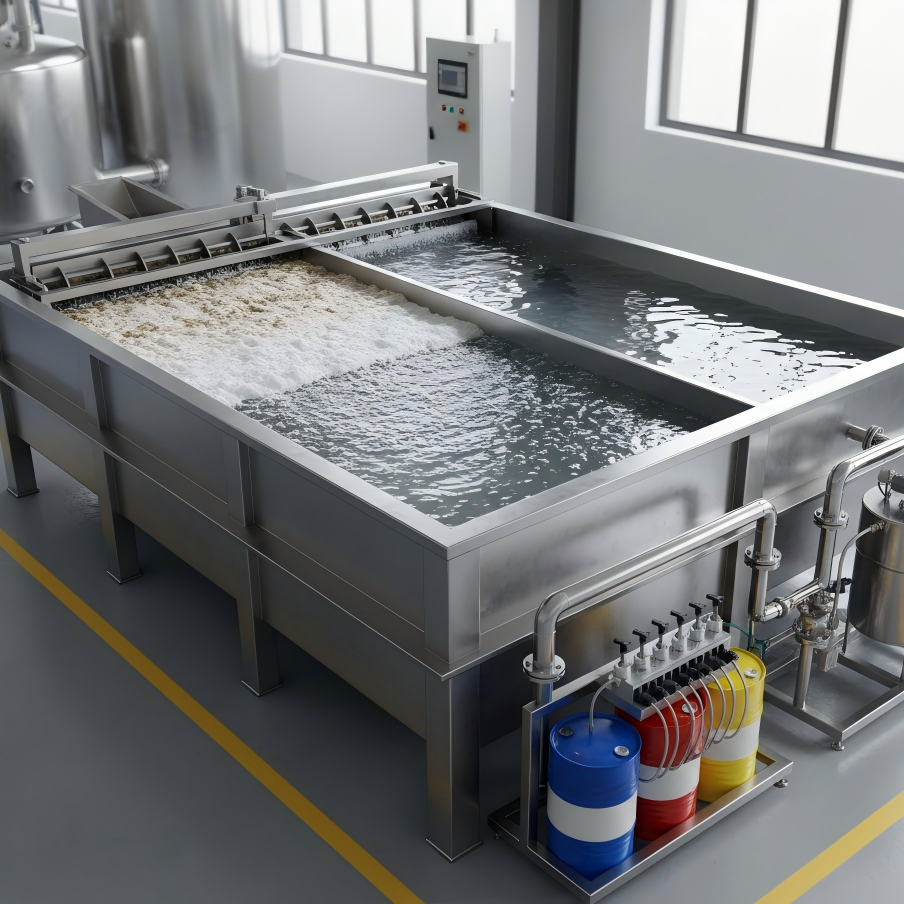
What is the working principle of dissolved air flotation?
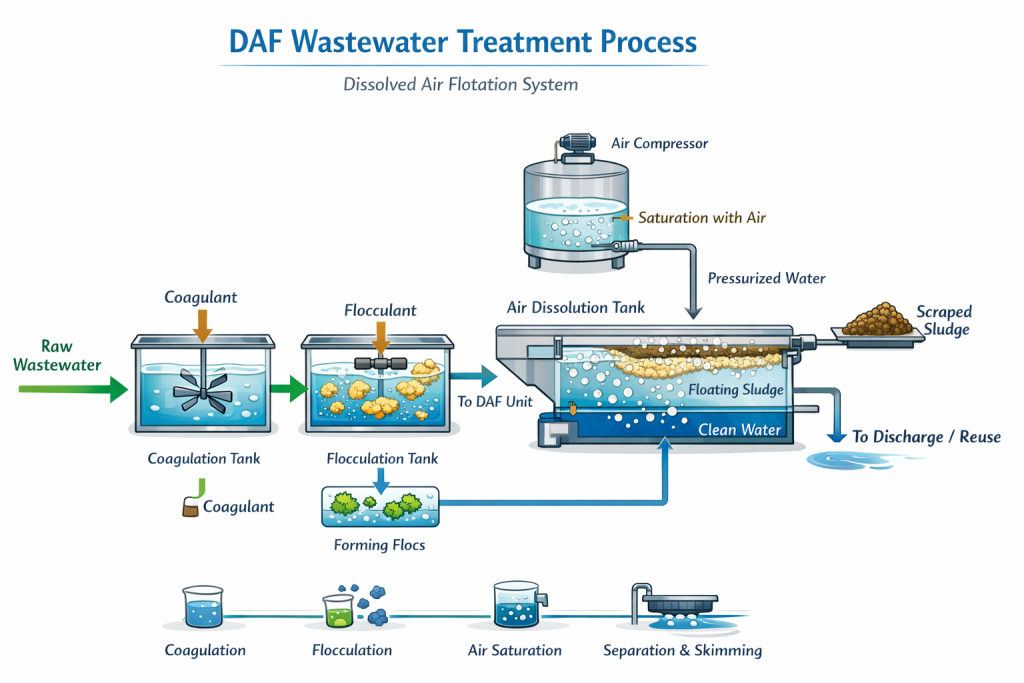
Dissolution Stage: Air is forcibly compressed into water under high pressure to form “dissolved air water.”
Release Stage: This pressurized water is injected into the wastewater tank. The sudden pressure release causes air to escape like opening a soda bottle cap, instantly generating countless micron-sized (20-50μm) fine bubbles.
Adsorption and Floating: These microbubbles adhere to suspended solids (SS), oils and greases (O&G), or flocculated matter within the wastewater.
Scum Removal: Due to the buoyancy of the bubbles, lightweight particles that were previously difficult to settle rapidly rise to the surface, forming a scum layer. This scum is ultimately removed by mechanical skimmers.
Why is DAF needed?
When treating wastewater, certain impurities are difficult to remove through natural gravitational settling, such as:
Oils and fats (lighter than water, they simply float on the surface).
Particles with densities close to water (they settle extremely slowly, making the process inefficient).
Algae or fibers (they tend to remain suspended).
The advantages of DAF are:
- High Speed: Processing efficiency is significantly higher than traditional sedimentation tanks.
- Compact Footprint: Due to rapid separation, the required tank volume is substantially smaller.
- Drier Sludge: Float scum on the water surface typically has a lower moisture content than settled sludge at the tank bottom, facilitating subsequent dewatering.
DAF Clarification Steps
Wastewater first undergoes pretreatment (such as screening) before entering the reaction zone. Here, chemical agents are added to cause fine impurities to aggregate into larger flocs. With the introduction of microbubbles, clear liquid remains at the bottom while sludge floats to the top.
Applications of Chemical Treatment
- To enhance DAF efficiency, chemical interventions are typically incorporated:
- Coagulants: Neutralize charges on particle surfaces.
- Flocculants: Bridge small particles into larger flocs, facilitating capture by bubbles.
Although the primary objective of DAF is to remove “scum,” a small amount of heavy particles will still settle to the bottom of the tank.
Scum Removal: A chain-type skimmer is installed at the top of the tank to periodically push scum into the sludge tank.
Bottom Sludge Removal: DAF clarifiers typically feature a funnel-shaped bottom or are equipped with a sludge scraper. Settled heavy sludge is periodically discharged through a sludge discharge valve to prevent accumulation.
How does the DAF system manage settled sludge?
In dissolved air flotation (DAF) systems, while most contaminants rise to the surface as scum due to bubble buoyancy, heavier solid particles—such as gravel, heavy metal oxides, or dense flocs not encapsulated by bubbles—will settle to the tank bottom.
Collection of Settled Sludge: V-Shaped Channels and Sludge Scrapers
- To prevent sediment accumulation at the tank bottom, odor formation, or gas interference from anaerobic reactions disrupting the flotation process, DAF tank bottoms are typically designed in two configurations:
- V-Shaped Conical Bottom: Commonly used in small to medium-sized systems. Sloped sidewalls allow settled sludge to naturally converge under gravity into a central collection channel at the tank bottom.
Bottom Scraper: In large or rectangular DAF tanks, alongside the top scum scraper, a bottom scraper system operates in reverse to push settled solids toward the discharge outlet.
Auto-Purge System
Sediment management is typically automated to ensure continuous system operation:
- Timed Discharge: PLC controllers set discharge cycles (e.g., every 4 hours), automatically opening pneumatic bottom valves.
- Differential Pressure/Concentration Monitoring: Advanced systems employ sludge level gauges or pressure sensors that trigger discharge commands when bottom sludge layers reach predetermined heights.
Subsequent Sludge Treatment
Discharged settled sludge typically has high moisture content and is combined with top scum for further processing:
- Sludge Thickening: Transferred to thickening tanks to reduce moisture content.
- Mechanical Dewatering: Processed using plate-and-frame filter presses, screw presses, or centrifuges to form “sludge cakes” for off-site disposal or landfill.
Conclusion
Dissolved Air Flotation (DAF) is not merely a simple “solid-liquid separation” device; it is a sophisticated system that seamlessly integrates physical mechanics with chemical reactions. By releasing micron-sized bubbles from high-pressure dissolved air, DAF successfully addresses the recovery challenges posed by lightweight suspended solids, emulsified oils, and fine flocs—substances that traditional sedimentation tanks struggle to treat effectively.
As a professional water treatment equipment manufacturer, GL is committed to providing high-performance DAF systems and comprehensive water treatment solutions. GL’s DAF equipment offers advantages such as compact design, stable operation, high treatment efficiency, and easy maintenance, meeting the diverse needs of various industrial and municipal projects. For more information about DAF systems and related water treatment equipment, please contact our professional team. We can provide customized solutions and technical support based on your water quality conditions and treatment requirements.