
The semiconductor industry ranks among the world’s most water-intensive and technologically demanding manufacturing sectors. From wafer cleaning, lithography, and etching to chemical mechanical polishing (CMP), production processes consume vast quantities of ultrapure water daily while generating equivalent or even greater volumes of wastewater.
Unlike conventional industrial wastewater, semiconductor effluent exhibits high complexity, significant water quality fluctuations, and heightened risk sensitivity. It typically contains acidic/alkaline substances, fluorides, heavy metals, ultrafine particles, organic solvents, and high-salinity components. With increasingly stringent environmental regulations and growing demand for water reuse, semiconductor wastewater treatment has evolved into a highly specialized systems engineering challenge.
What Is Semiconductor Wastewater Treatment?
Semiconductor wastewater treatment refers to the comprehensive management of wastewater generated during semiconductor manufacturing, encompassing classification, targeted treatment, reuse, or compliant discharge. This process typically integrates multiple technologies—including physical, chemical, biological, and membrane separation—to meet the following objectives:
- Strict environmental discharge standards
- High water reuse rates
- Zero Liquid Discharge (ZLD) targets for advanced fabs
Why is Semiconductor Wastewater Particularly Difficult to Treat?
- Water composition is highly complex and frequently fluctuates
Wastewater generated from different process steps varies significantly in composition, rendering a “one-size-fits-all treatment solution” impractical in real-world applications.
- Contains high-risk contaminants
Common contaminants include:
- Hydrofluoric acid (HF)
- Fluorinated compounds and ammonium salts
- Heavy metals such as copper, nickel, and chromium
- Photoresists and organic solvents
- Extremely stringent requirements for reclaimed water quality
Reclaimed water often enters ultra-pure water (UPW) systems, where even trace impurities can impact chip yield.
- Increasingly high reuse rates and ZLD requirements
More and more fabs demand water reuse rates exceeding 70–90%, with some advanced processes mandating zero liquid discharge.
Classification of Semiconductor Wastewater
- Acid / Alkali Wastewater
- Fluoride Wastewater
- Heavy Metal Wastewater
- CMP Wastewater
- Organic Wastewater
- High Salinity Wastewater
Core Diversion of Semiconductor Wastewater
In semiconductor wastewater treatment, the most important principle is segregation before treatment. Semiconductor manufacturing generates multiple wastewater streams with very different chemical compositions and contaminants. If these streams are mixed before treatment, it can increase treatment difficulty, reduce system stability, and raise operating costs.
Typical streams include acid and alkaline wastewater, fluoride wastewater, heavy metal wastewater, CMP wastewater, organic wastewater, and high-salinity wastewater. Each stream requires specific treatment technologies, such as chemical precipitation for fluoride and heavy metals, solid-liquid separation for CMP wastewater, and membrane or evaporation treatment for high-salinity wastewater.
Proper segregation improves removal efficiency, reduces chemical consumption and sludge production, and helps protect downstream membrane and ZLD systems. In modern semiconductor fabs, segregation is a fundamental part of wastewater system design.
Typical Semiconductor Wastewater Treatment Technologies
Semiconductor wastewater treatment typically requires a combination of chemical, physical, and advanced treatment technologies. Because semiconductor wastewater contains a wide range of contaminants—including acids, fluorides, heavy metals, fine particles, organic solvents, and high-salinity streams—no single treatment technology can meet all treatment requirements. Instead, integrated multi-stage treatment systems are commonly used.
Chemical Treatment
Chemical treatment is usually the first step in semiconductor wastewater treatment. It is mainly used to control pH and remove dissolved contaminants such as fluorides and heavy metals.
Typical processes include:
- Acid and alkali neutralization
- Calcium precipitation for fluoride removal
- Hydroxide or sulfide precipitation for heavy metal removal
Solid–Liquid Separation
Solid-liquid separation is critical for removing suspended solids, chemical precipitates, and CMP polishing particles.
Common technologies include:
- Clarifiers or sedimentation tanks
- Lamella clarifiers
- Dissolved Air Flotation (DAF) systems
Effective solid removal helps prevent membrane fouling and improves overall system stability.
Advanced Oxidation Processes
Advanced oxidation is mainly used to remove refractory organic contaminants such as photoresists and solvents.
Typical technologies include:
- Ozone oxidation
- UV/Ozone
- UV/H₂O₂
These processes improve biodegradability and reduce organic toxicity.
Membrane Treatment Technologies
Membrane systems play a key role in water reuse and desalination.
Common membrane processes include:
- Ultrafiltration (UF) for particle and colloid removal
- Reverse Osmosis (RO) for dissolved salt removal and water reuse
Membrane treatment is essential for achieving high water recovery rates in semiconductor facilities.
Evaporation and Crystallization
For high-salinity wastewater and RO concentrate streams, thermal treatment is often required.
Typical systems include:
- MVR evaporators
- Multi-effect evaporators
- Crystallizers
These systems enable zero liquid discharge (ZLD) and maximize water recovery.
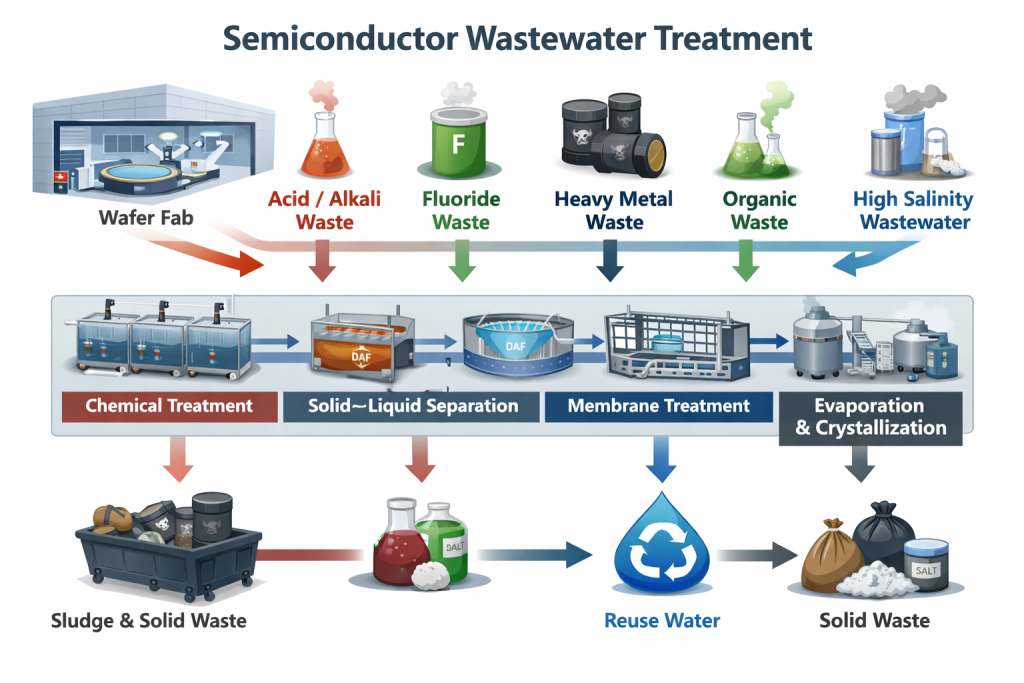
Water Reuse and ZLD in Semiconductor Industry
The semiconductor industry is increasingly adopting high water reuse rates and Zero Liquid Discharge (ZLD) systems due to strict environmental regulations and growing water resource pressure. Many advanced fabs now achieve 70–90% water reuse, while ZLD systems are becoming more common in water-scarce regions.
Water reuse is typically achieved using membrane technologies such as UF and RO, while ZLD systems combine membrane concentration, evaporation, and crystallization to maximize water recovery and minimize wastewater discharge.
Conclusion
As environmental regulations continue to tighten and water resource pressures persistently increase, the semiconductor industry is gradually shifting from traditional compliance-based discharge toward high reuse rates and resource recovery.
GL specializes in water treatment, dedicated to providing industrial clients with reliable, high-efficiency water treatment equipment and system solutions. Contact us today. With extensive experience in complex industrial wastewater treatment, advanced purification, and reuse system integration, we deliver professional, sustainable engineering solutions tailored to specific water quality characteristics and project requirements.