
What Is Reverse Osmosis Water Treatment?
Reverse Osmosis Water Treatment is a membrane-based separation technology widely used to remove dissolved salts, organic matter, and contaminants from water. By applying pressure greater than the natural osmotic pressure, water molecules are forced through a semi-permeable membrane, leaving impurities behind.
What Is Reverse Osmosis Water?
Reverse osmosis water refers to purified water produced by an RO system, where most dissolved solids (TDS), bacteria, and impurities are removed.
- Low TDS (total dissolved solids).
- High purity.
- Consistent water quality.
- Removal of most inorganic salts and microorganisms.
It is typically used for:
- Industrial pure water
- Boiler feedwater
- Water for the pharmaceutical and electronics industries
How Does a Reverse Osmosis System Work?
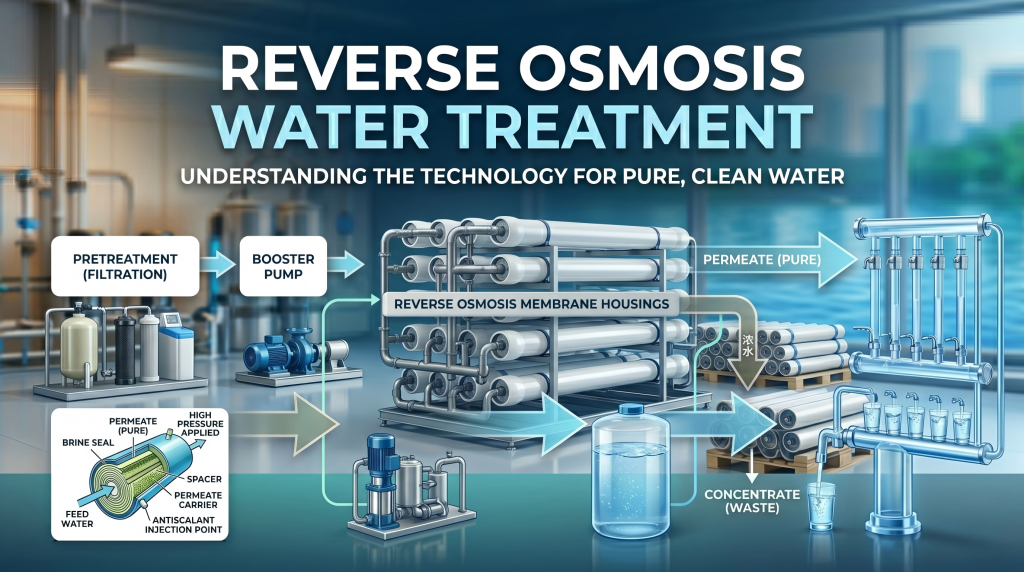
Pretreatment
- Sand filter
- Activated carbon filter
- Cartridge filter
High-Pressure Pump
Provide sufficient pressure to push water through the RO membrane.
RO Membrane Separation
- Core Desalination Process.
- Removes 99% of dissolved salts.
Post-Treatment
UV Disinfection / pH Adjustment / Polishing Mixed-Bed System.
What Contaminants Does the Reverse Osmosis Process Remove?
- Dissolved salts
- Heavy metals
- Bacteria and viruses
- Organic compounds
- Nitrates and sulfates
- Microplastics
What Is The Difference Between Reverse Osmosis And Filtration?
| Parameter | Reverse Osmosis (RO) | Conventional Filtration |
|---|---|---|
| Working Principle | Semi-permeable membrane separation at molecular level | Physical particle separation |
| Contaminants Removed | Dissolved salts, ions, bacteria, viruses | Suspended solids and large particles |
| Filtration Accuracy | Extremely high (nanometer scale) | Moderate (micron scale) |
| Operating Pressure | Requires high pressure pump | Typically low or no pressure |
| Typical Applications | Desalination, ultrapure water, industrial water treatment | Pre-filtration, solid removal |
What Are The Benefits of Reverse Osmosis?
- High desalination efficiency
- Stable water quality
- Wide applicability
- Automated operation
- Compact system design
Conclusion
Reverse Osmosis Water Treatment has become a critical technology for modern water purification, offering high-efficiency desalination and reliable water quality across industrial applications.
At GL Environment, we provide complete reverse osmosis water treatment solutions, including system design, equipment supply, and technical support tailored to industrial applications.
Contact us today to customize your reverse osmosis system.