
UV water treatment is a highly efficient and environmentally friendly disinfection method widely used in drinking water, wastewater, and industrial applications. Unlike chemical disinfection, UV technology uses light to inactivate microorganisms instantly—without adding chemicals or producing harmful by-products.
What Is UV Water Treatment?
UV water treatment is a physical disinfection process that uses UV-C light (around 254 nm) to inactivate bacteria, viruses, and protozoa.
Key features:
- No chemical additives
- No change in taste or odor
- No harmful disinfection by-products
- Instant disinfection process
How UV Water Treatment Works?
The UV disinfection process works as follows:
- Water flows through a UV reactor
- A UV lamp emits UV-C radiation
- UV light penetrates microorganisms
- It damages their DNA or RNA
- Microorganisms lose the ability to reproduce
Key point: UV does not “kill” microorganisms—it inactivates them.
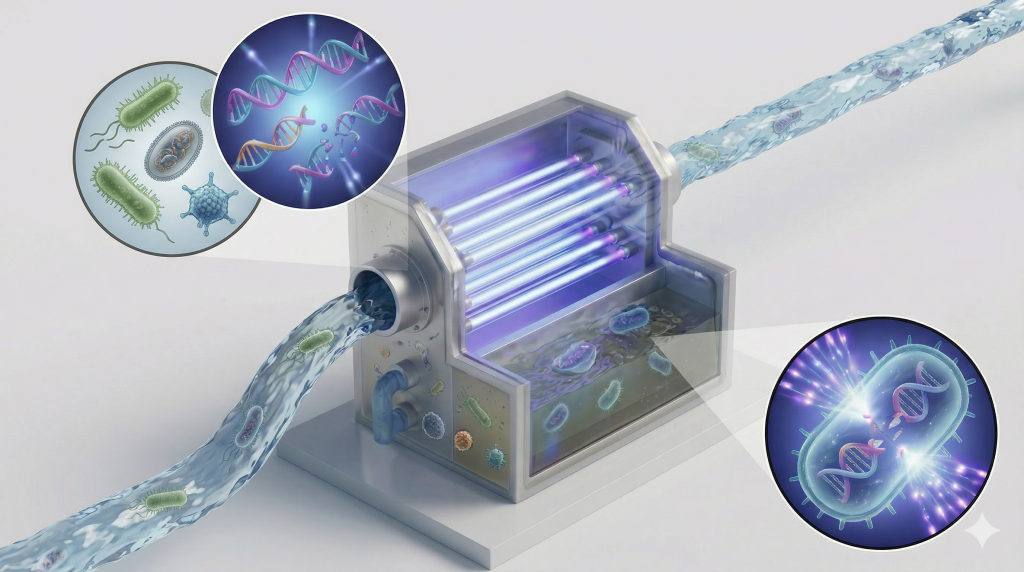
Key Components of a UV System
- UV Lamp – Produces UV-C light
- Quartz Sleeve – Protects the lamp and allows UV transmission
- Reactor Chamber – Controls exposure time
- Ballast/Controller – Regulates power supply
- UV Sensor (optional) – Monitors intensity
Advantages of UV Water Treatment
Chemical-Free
No chlorine or chemicals required.
High Disinfection Efficiency
Removes up to 99.99% of pathogens, including chlorine-resistant organisms.
Instant Action
No contact time required—works in seconds.
No By-products
Does not produce THMs or other harmful compounds.
Low Operating Cost
Simple maintenance and relatively low energy consumption.
Limitations of UV Water Treatment
- No residual disinfection (risk of recontamination)
- Sensitive to water quality (turbidity, UVT)
- Does not remove chemicals or heavy metals
- UV lamps require periodic replacement
UV Lamp Types and Technologies
Different UV lamps significantly affect performance:
Low-Pressure (LP) Lamps
- Emit at 254 nm
- Energy-efficient
- Suitable for standard disinfection
Medium-Pressure (MP) Lamps
- Broad spectrum output
- Higher intensity
- Suitable for high-flow or advanced applications
UV-LED (Emerging)
- Compact and energy-saving
- Longer lifespan
- Ideal for future smart systems
Key Parameters: UV Dose & UVT
UV Dose
UV Dose = Intensity × Time (mJ/cm²)
Typical design values:
- Drinking water: 30–40 mJ/cm²
- Wastewater: 40–100 mJ/cm²
UVT (UV Transmittance)
UVT measures how well UV light penetrates water:
- UVT ≥ 85% → High efficiency
- UVT ≤ 70% → Reduced performance
Factors affecting UVT:
- Turbidity
- Suspended solids
- Organic matter (COD)
- Iron and manganese
Impact of UVT on System Performance
UVT (UV Transmittance) directly affects how much UV energy reaches microorganisms.
- High UVT → Better penetration → Higher efficiency
- Low UVT → Energy loss → Reduced disinfection
Example:
A system designed for 90% UVT may underperform significantly at 70% UVT.
Solution:
- Add pre-treatment (filtration, coagulation)
- Increase UV dose
- Reduce flow rate
Applications of UV Water Treatment
Drinking Water
Used in municipal plants and residential systems.
Wastewater Treatment
Final disinfection before discharge or reuse.
Industrial Water
Applied in:
- Food & beverage
- Pharmaceuticals
- Electronics
Aquaculture & Pools
Controls microbial growth and improves water quality.
UV vs Chlorine vs Ozone
| Feature | UV | Chlorine | Ozone |
| Disinfection | High | High | Very High |
| Residual Effect | None | Yes | Limited |
| By-products | None | Yes | Possible |
| Removes COD | No | No | Yes |
| Cost | Low | Low | High |
Common combinations:
- UV + Chlorine
- UV + Ozone (AOP)
System Selection Tips
When selecting a UV system, consider:
- Flow rate (m³/h)
- UVT level
- Target microorganisms
- Water quality (turbidity, COD)
- Installation type (inline or open channel)
Core principle:
Design based on required UV dose—not just equipment size.
Maintenance Guidelines
- Replace UV lamps every 8,000–12,000 hours
- Clean quartz sleeves regularly
- Monitor UV intensity
- Ensure stable power supply
Summary
UV water treatment is a safe, efficient, and sustainable disinfection solution. It is especially suitable for applications requiring chemical-free treatment and high microbiological safety.
However, to achieve optimal performance, UV systems must be properly designed based on UVT, water quality, and required dose.
Whether for municipal, industrial, or reuse water systems, we help you build a reliable and cost-effective UV solution. Contact us today to get your tailored UV water treatment system!