
Textile wastewater treatment is one of the most important and technically demanding areas of industrial wastewater management. Textile manufacturing processes such as desizing, scouring, bleaching, mercerizing, dyeing, printing, washing, and finishing generate large volumes of wastewater containing dyes, surfactants, salts, suspended solids, organic matter, and process chemicals. Textile mill wastewater commonly exhibits high color, elevated COD, fluctuating pH, and significant dissolved solids, which makes direct discharge or simple treatment inadequate in many cases.
Why Is Textile Wastewater So Difficult to Treat?
Textile wastewater is not a single, uniform stream. Its composition changes depending on:
- Fiber type (cotton, polyester, blended fabrics, wool, etc.)
- Process stage
- Dye class
- Auxiliary chemicals used
- Washing intensity
- Production schedule
- Water reuse practices within the factory
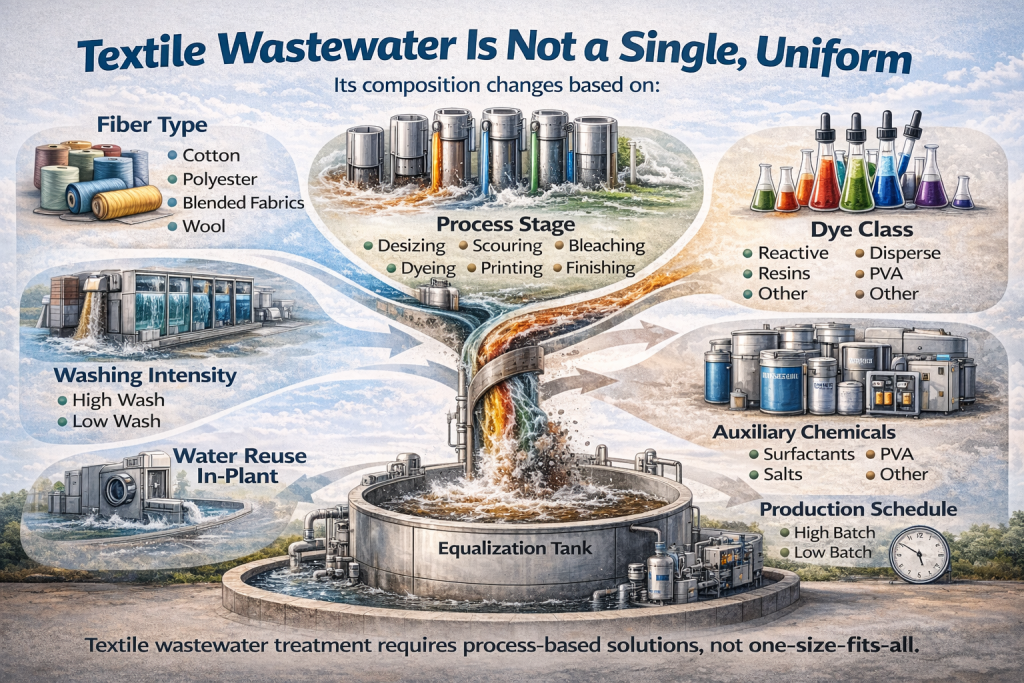
This variability is exactly why many textile treatment systems underperform: they are designed for “average wastewater,” while real textile wastewater is highly dynamic.
Common Characteristics of Textile Wastewater
Textile effluent often contains:
- Strong color from reactive, azo, vat, sulfur, disperse, or direct dyes
- High COD and BOD
- High alkalinity or pH fluctuation
- Suspended solids
- Surfactants and detergents
- Starch, sizing agents, and finishing chemicals
- Salts such as sodium chloride and sodium sulfate
- Heavy metals in some specialty dyeing or printing lines
- Oxidants and bleaching residues
- Temperature fluctuation
Main Sources of Wastewater in Textile Processing
To properly treat textile wastewater, it is essential to understand where the pollution load comes from.
1. Desizing
Desizing removes starch, polyvinyl alcohol (PVA), carboxymethyl cellulose, and other sizing agents from yarn or fabric. This stream often contributes:
- High COD
- High BOD
- Suspended solids
- Variable biodegradability
2. Scouring
Scouring removes oils, waxes, pectins, and natural impurities. Wastewater from this step may contain:
- Oils and grease
- High alkalinity
- Surfactants
- Organic load
3. Bleaching
Bleaching uses oxidants such as hydrogen peroxide or hypochlorite to improve whiteness. Bleaching wastewater may contain:
- Residual oxidants
- High pH
- Temperature fluctuations
- Reduced biological treatment stability if not neutralized
4. Mercerizing
Mercerizing commonly uses sodium hydroxide, creating wastewater with:
- Very high pH
- High conductivity
- High dissolved solids
5. Dyeing and Printing
This is often the most problematic section. Dyeing and printing wastewater may include:
- Unfixed dyes
- Color bodies
- Salt
- Surfactants
- Dispersing agents
- Reducing agents
- Complex organics
6. Finishing and Washing
Finishing lines may introduce:
- Softeners
- Resins
- Formaldehyde-related compounds
- Specialty chemicals
- Rinse water contamination
Key Challenges in Textile Wastewater Treatment
1. High Color
Color is often the most visible and difficult pollutant in textile wastewater. Many dyes are designed to be chemically stable and resistant to light, oxidation, and biodegradation. That makes them difficult to remove using biological treatment alone.
2. High COD with Low Biodegradability
Some textile wastewater contains organic compounds that are not easily degraded by microorganisms. This means:
- Conventional activated sludge may underperform
- Biological systems may need pretreatment support
- Chemical oxidation or coagulation is often necessary
3. High Salt Content
Reactive dyeing often uses large quantities of salt, especially sodium chloride or sodium sulfate. High salinity can:
- Inhibit biological activity
- Limit water reuse
- Increase membrane fouling and osmotic pressure challenges
4. Shock Loads and Batch Discharges
Many textile dye houses operate in batch mode. That means wastewater quality and flow can change dramatically throughout the day, causing:
- pH swings
- COD spikes
- Color spikes
- Biological process instability
5. Sludge Generation
Chemical treatment for textile wastewater can be highly effective, but it also generates sludge. Without proper sludge thickening and dewatering, operating costs rise quickly.
How Is Textile Wastewater Treated?
The treatment of textile wastewater is an extremely challenging process, primarily due to its complex composition: high color intensity, high chemical oxygen demand (COD), high salinity, and the presence of heavy metals and toxic synthetic dyes.
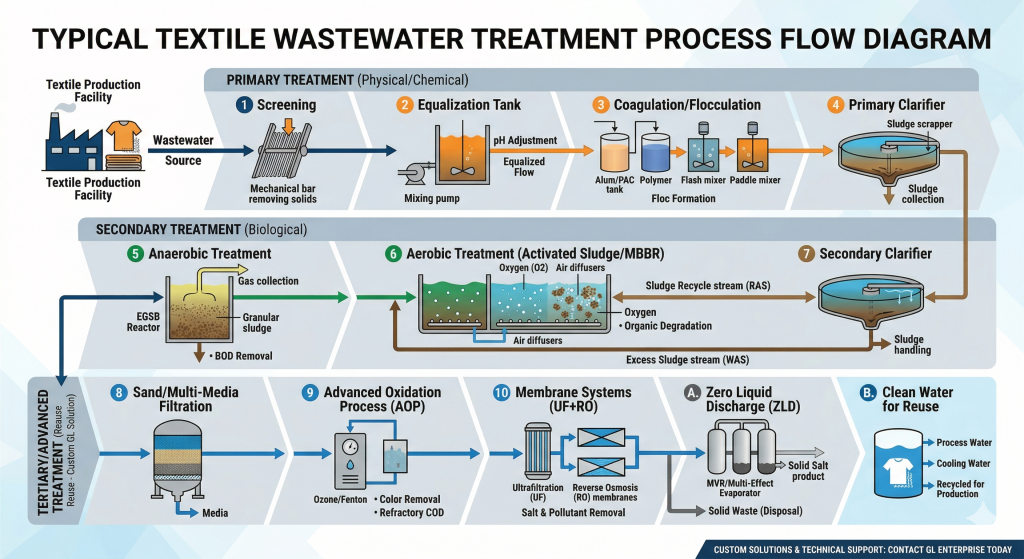
Pretreatment (Physical and Chemical Methods)
This is the first line of defense in the treatment process, designed to remove large particulate impurities and adjust water quality.
- Bar screens and mesh screens: Intercept lint, fibers, and floating debris.
- Equalization tank: Textile production is intermittent, and the pH and temperature of the effluent vary significantly between different time periods. The equalization tank mixes the wastewater to ensure uniformity and stabilizes the load for subsequent treatment.
- Coagulation-Flocculation: Alum or polyaluminum chloride (PAC) is added to cause fine suspended solids and some dye particles in the wastewater to form larger “flocs” that settle out.
Biological Treatment
- Anaerobic Treatment: In an oxygen-free environment, anaerobic bacteria break down complex dye molecules (such as azo bonds) to improve the biodegradability of the wastewater.
Aerobic Treatment:
- Activated Sludge Process (ASP): The most commonly used method, which involves supplying oxygen through aeration to allow bacteria to break down residual organic matter.
- MBBR (Moving Bed Biofilm Reactor): Plastic media is added to the tank to support biofilm growth on the surface, resulting in higher efficiency and greater resistance to shock loads compared to traditional methods.
Advanced Treatment
If the wastewater is to be directly reused in the production line or must meet extremely stringent discharge standards, the following step is required: Advanced Oxidation Processes (AOPs): Using ozone, Fenton’s reagent, or UV-catalyzed reactions to generate highly reactive hydroxyl radicals, which completely break down the color of residual dyes.
- Ultrafiltration (UF): Intercepts colloids and macromolecules.
- Reverse Osmosis (RO): Removes dissolved salts, producing water of a quality that nearly meets drinking water standards, which can be directly reused in the dyeing process.
Zero Liquid Discharge (ZLD)
As environmental regulations become increasingly stringent, many plants are transitioning to “zero liquid discharge”.
This typically involves using multi-effect evaporation (MEE) or mechanical vapor recompression (MVR) technologies to evaporate concentrated brine—which has been filtered through reverse osmosis (RO)—into solid salt, thereby achieving 100% water reuse.
Conclusion
Textile wastewater treatment is no longer merely a “mandatory requirement” for companies to comply with environmental regulations; it has become a core indicator of a company’s capabilities. From basic physical and chemical precipitation to cutting-edge Zero Liquid Discharge (ZLD) technology, every process upgrade serves as a powerful safeguard for the ecological environment.
As a GL-driven company, we are committed to combining state-of-the-art water treatment technologies, advanced oxidation processes, and intelligent management systems to provide the industry with more efficient and cost-effective environmental solutions. Given the varying production processes, fabric materials, and discharge requirements across different factories, one-size-fits-all solutions often fail to deliver the best value for money. The GL professional team is now offering personalized, in-depth consulting services.