
In water and wastewater treatment, many suspended particles and colloidal pollutants are too small to settle naturally. Flocculation helps solve this problem by adding coagulants or polymers and applying controlled mixing to aggregate fine particles into larger flocs that can be easily removed through sedimentation, flotation, or filtration. The efficiency of this process largely depends on key parameters such as pH conditions, mixing intensity (G value), GT value, and hydraulic retention time, all of which influence the formation and stability of flocs.
What is flocculation water treatment?
Flocculation is a step in water treatment that aggregates minute suspended particles into larger flocs.
These larger flocs are more readily removed from water through sedimentation, flotation, or filtration, so flocculation is typically performed after coagulation.
Applications of Flocculation
Flocculation is widely applied in water treatment. In many water treatment processes, flocculation serves as a critical step for enhancing solid-liquid separation efficiency.
- Enhanced Sedimentation and Phosphorus Removal
- Solid-Liquid Separation for Industrial Wastewater
- Drinking Water Purification
- Dissolved Air Flotation System
- Sludge Dewatering Treatment
Control of Key Process Parameters
| Parameter | Recommended Range / Logic | Expert Commentary |
|---|---|---|
| G Value (Velocity Gradient) | 20 – 70 s⁻¹ | Follow the principle of “decreasing energy input.” Higher mixing intensity is required at the beginning to promote particle collisions, while lower mixing speeds later help prevent floc breakage. |
| GT Value (Dimensionless) | 10⁴ – 10⁵ | Represents the overall collision probability between particles. If too low, flocculation is insufficient; if too high, it wastes energy and may break formed flocs. |
| Hydraulic Retention Time (HRT) | 15 – 30 min | Adequate time is required for polymer chains to unfold and for flocs to grow, ensuring stable and effective floc formation. |
Table of Control of Key Process Parameters
Why is flocculation important in water treatment?
- Enhancing Solid-Liquid Separation Efficiency
Many pollutants in water are extremely fine particles that cannot be effectively removed through natural sedimentation alone. Through flocculation, these minute particles aggregate to form larger flocs, making them easier to settle in sedimentation tanks or separate in flotation systems. This significantly improves solid-liquid separation efficiency.
- Reducing Water Turbidity and Suspended Solids
Flocculation effectively removes suspended solids (SS), colloidal particles, and some organic matter from water, thereby lowering turbidity and improving effluent quality. This is particularly crucial in drinking water treatment and advanced wastewater treatment processes.
- Enhancing Pollutant Removal Efficiency
Numerous pollutants—such as phosphorus, heavy metals, and organic compounds—adhere to flocs. The larger particles formed through flocculation can be more readily captured by sedimentation or flotation systems, thereby significantly improving the overall efficiency of pollutant removal.
- Enhancing Subsequent Treatment Process Performance
An effective flocculation process creates more stable operating conditions for downstream treatment units. For example:
- In DAF flotation systems, larger flocs attach to bubbles and rise more readily.
- In filtration systems, larger particles are more easily retained by filter media.
- During sludge dewatering, flocculated sludge exhibits a more stable structure, facilitating easier dewatering.
- Reducing Operating Costs
Optimizing the flocculation process reduces the load on subsequent treatment equipment, improves system efficiency, and to some extent lowers energy consumption and operating costs.
How does flocculation occur in water treatment?
In water treatment processes, flocculation is the process of aggregating minute particles in water into larger flocs, thereby facilitating their removal through sedimentation, flotation, or filtration. Flocculation typically occurs after coagulation, with slow agitation promoting collisions and bonding between particles.
- Add coagulants
The flocculation process first requires adding coagulants to the water, such as PAC (poly aluminum chloride), iron salts, etc. These chemical agents neutralize the charges on the surfaces of colloidal particles in the water, allowing particles that would otherwise repel each other to come into close proximity. - Formation of Micro-Particles
Once the charges are neutralized, minute particles in the water begin to aggregate, forming clusters of smaller particles. This stage is commonly referred to as the micro-flocculation formation phase.
3. Slow agitation promotes particle collision
In the flocculation tank, slow agitation (typically using paddle agitators) causes particles in the water to continuously collide and combine. Over time, these minute particles gradually form larger flocs.
4. Formation of Stable Flocs
As flocs continue to grow, their weight and volume increase, eventually forming visible floc particles. These flocs can be effectively separated in subsequent treatment processes, such as:
- Settling in sedimentation tanks
- Floating in dissolved air flotation (DAF) systems
- Being retained in filtration systems
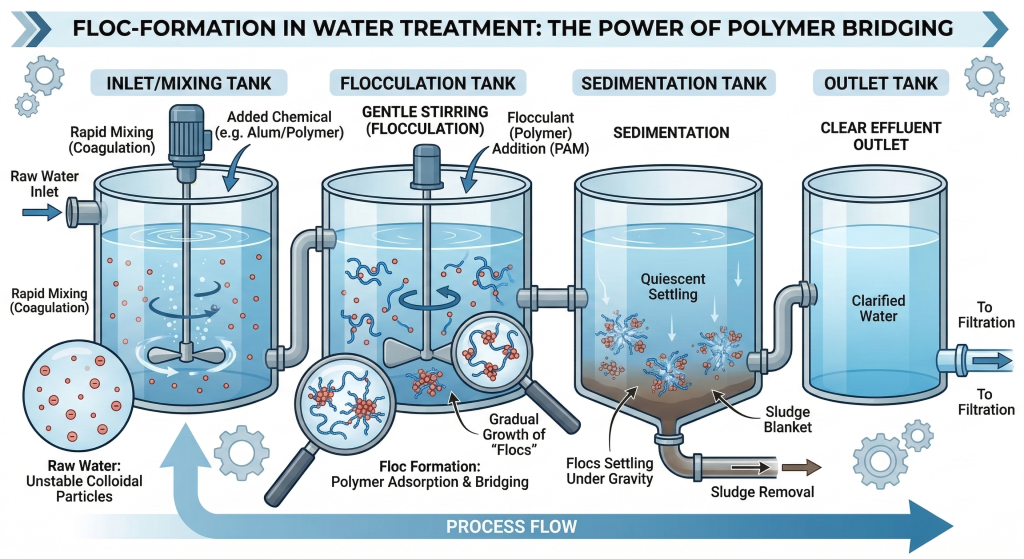
The Importance of pH Value and Mixing in Flocculation Water Treatment
In the flocculation process of water treatment, pH control and mixing conditions are two critical factors affecting floc formation efficiency. If pH or mixing conditions are improperly controlled, flocculation efficiency may significantly decrease even when the correct dosage of chemical is applied.
The Effect of pH on Flocculation Reactions
Flocculants (such as PAC, iron salts, etc.) must undergo hydrolysis reactions in water to form effective flocs, and this process is highly sensitive to pH levels.
When pH is within the optimal range, the chemical can fully react and form stable flocs, thereby enhancing the removal efficiency of suspended solids and pollutants. If pH deviates from the optimal range, it may lead to difficulty in floc formation or unstable floc structure.
For example:
- At excessively low pH, chemical hydrolysis is incomplete.
- At excessively high pH, floc structure may become loose.
Effect of Mixing Ratio on Flocculation Performance
The mixing process is typically divided into two stages: rapid mixing and slow agitation.
After chemical addition, rapid mixing is first required to achieve uniform dispersion of the chemical in water, ensuring thorough contact with suspended particles. Subsequently, slow agitation enables continuous particle collisions, gradually forming larger flocs.
Insufficient mixing may result in uneven chemical distribution, compromising flocculation efficiency. Conversely, excessive agitation intensity risks disrupting already formed flocs.
pH and Synergistic Effects of Mixing
In practical water treatment processes, pH control and mixing conditions often require simultaneous optimization. Only under appropriate pH conditions, combined with adequate mixing intensity, can flocs form stably and be effectively removed during subsequent sedimentation, flotation, or filtration processes.
Conclusion
Effective flocculation is essential for improving solid-liquid separation and enhancing the removal of suspended solids, phosphorus, and other contaminants in water treatment systems. By optimizing reaction conditions and process parameters, treatment performance can be significantly improved.
At GL Environment, we focus on providing integrated water and wastewater treatment solutions, helping clients design efficient and reliable treatment systems that meet increasingly strict environmental standards. Please feel free to contact our professional technical team for your solution requirements.