
Hard water treatment is an important process for homes, commercial buildings, and industrial water systems. Hard water contains high levels of dissolved minerals, mainly calcium and magnesium. Although hard water is not usually harmful to human health, it can cause scaling, reduce equipment efficiency, block pipes, and increase maintenance costs.
For industries that rely on boilers, cooling towers, pumps, pipelines, water heaters, or dosing systems, untreated hard water can create serious operational problems. Choosing the right hard water treatment method helps improve water quality, protect equipment, and reduce long-term costs.
What Is Hard Water?
Hard water is water with a high concentration of calcium and magnesium ions. These minerals usually enter water when groundwater passes through limestone, chalk, or mineral-rich rocks.
The hardness level of water is often measured as calcium carbonate, expressed in mg/L or ppm. The higher the mineral content, the harder the water.
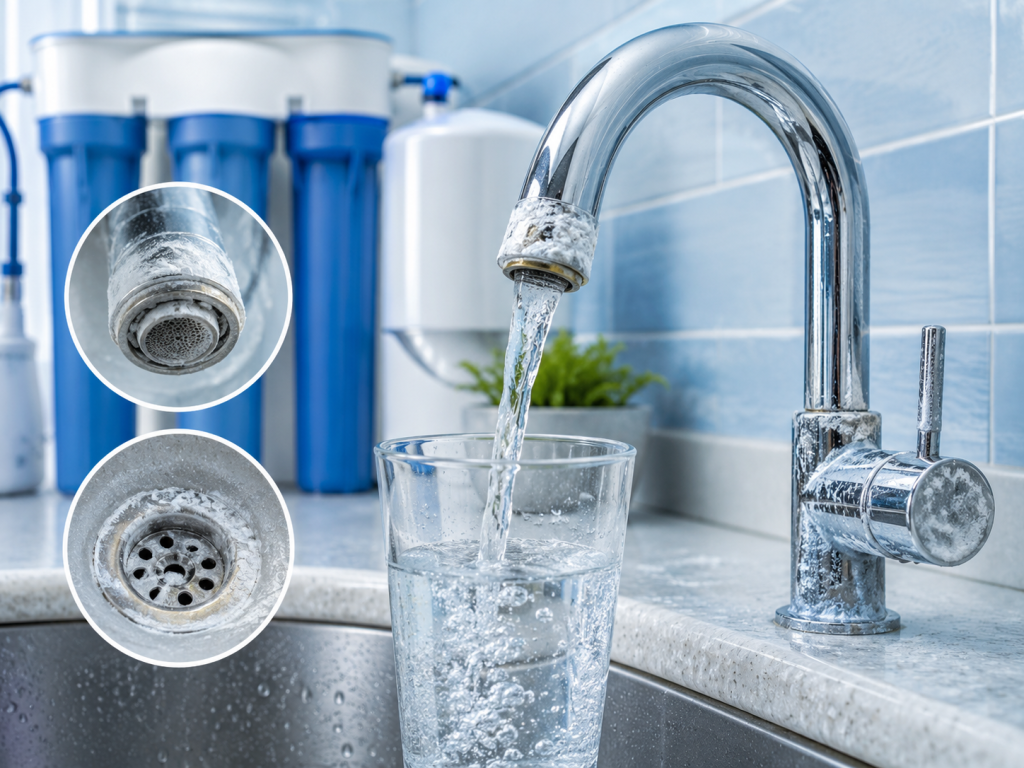
Common signs of hard water include:
| Sign | Description |
| Scale buildup | White deposits on pipes, faucets, heaters, and equipment |
| Poor soap performance | Soap or detergent produces less foam |
| Stains | White marks on glass, tiles, and metal surfaces |
| Reduced heating efficiency | Scale acts as insulation inside boilers and heaters |
| Pipe blockage | Long-term scaling can reduce water flow |
Why Hard Water Needs Treatment
Hard water can create problems in both domestic and industrial applications. In industrial systems, calcium and magnesium can precipitate when water is heated or concentrated. This forms hard scale on equipment surfaces.
Scale buildup can lead to:
| Problem | Impact |
| Lower heat transfer efficiency | Higher energy consumption |
| Blocked pipes and valves | Reduced flow and system pressure |
| Equipment wear | Shorter service life |
| Higher chemical consumption | More cleaning and maintenance required |
| Unstable water quality | Affects production and treatment processes |
For boilers, cooling systems, RO pretreatment, food processing, textile production, and chemical manufacturing, hard water treatment is especially important.
Main Hard Water Treatment Methods
Ion Exchange Water Softening
Ion exchange is one of the most common hard water treatment methods. It uses resin beads to replace calcium and magnesium ions with sodium or potassium ions.
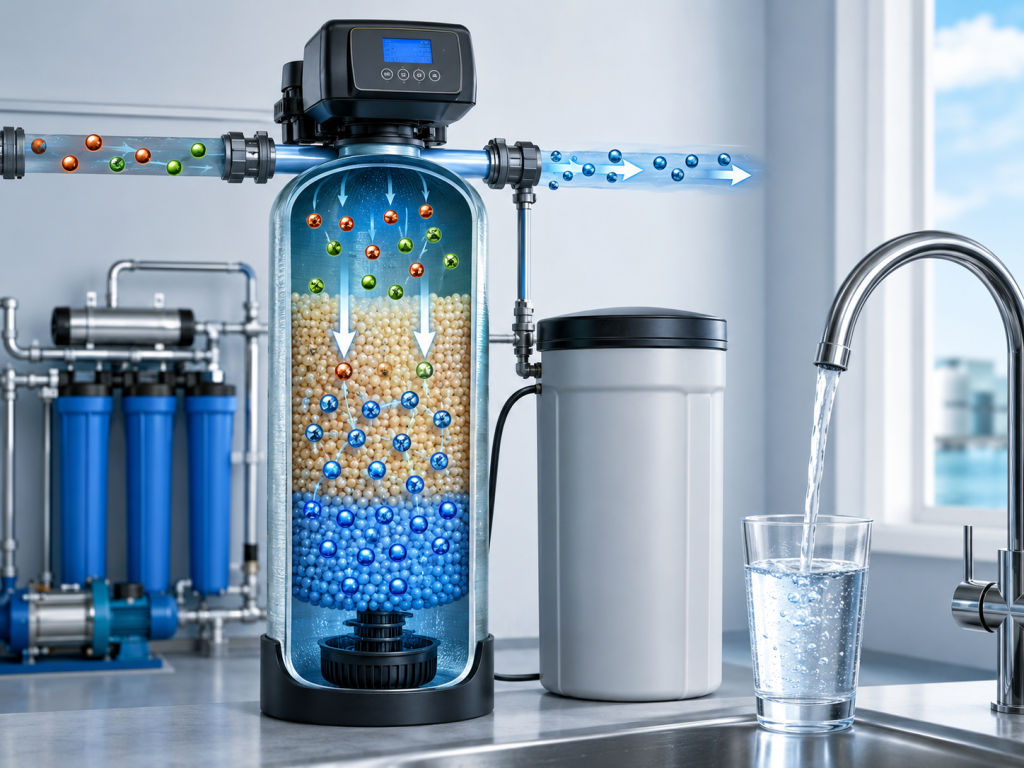
This method is widely used in residential, commercial, and industrial water softeners.
Advantages:
| Advantage | Description |
| High softening efficiency | Effectively removes calcium and magnesium |
| Stable performance | Suitable for continuous operation |
| Mature technology | Easy to install and maintain |
Limitations:
| Limitation | Description |
| Requires regeneration | Salt or chemical regeneration is needed |
| Produces wastewater | Regeneration creates brine discharge |
| Not suitable for all applications | Sodium increase may not be acceptable in some processes |
Chemical Dosing Treatment
Chemical dosing is commonly used in industrial water systems. Chemicals such as scale inhibitors, dispersants, and pH adjusters are added to prevent minerals from forming hard scale.
This method does not remove hardness minerals directly, but it controls their behavior in the system.
Common applications:
| Application | Purpose |
| Cooling towers | Prevent scale and corrosion |
| Boilers | Reduce scaling risk |
| Circulating water systems | Keep pipelines clean |
| Industrial process water | Improve system stability |
Chemical dosing systems usually include a dosing pump, chemical tank, controller, and online monitoring instruments.
Reverse Osmosis
Reverse osmosis, or RO, uses a semi-permeable membrane to remove dissolved salts, minerals, and impurities from water. It can significantly reduce water hardness and total dissolved solids.
RO is often used when high-purity water is required.
Advantages:
| Advantage | Description |
| High removal efficiency | Removes hardness, salts, and many impurities |
| Produces high-quality water | Suitable for sensitive industrial processes |
| Can be combined with pretreatment | Improves overall system performance |
Limitations:
| Limitation | Description |
| Requires pretreatment | Hard water may cause membrane scaling |
| Higher investment cost | More complex than simple softening |
| Produces concentrate water | Wastewater management is needed |
Lime Softening
Lime softening uses lime or lime-soda chemicals to precipitate calcium and magnesium from water. This method is commonly used in municipal and large-scale industrial water treatment.
It is suitable for treating large volumes of hard water.
Advantages:
| Advantage | Description |
| Suitable for large systems | Effective for municipal and industrial use |
| Reduces hardness significantly | Removes calcium and magnesium |
| Can remove some heavy metals | Additional treatment benefit |
Limitations:
| Limitation | Description |
| Requires sludge handling | Precipitated solids must be removed |
| Needs careful control | pH and chemical dosage must be managed |
| Larger footprint | Requires tanks and clarification equipment |
Magnetic or Physical Water Conditioners
Magnetic or electronic water conditioners are designed to change the crystallization behavior of hardness minerals. They do not remove calcium or magnesium from water, but they may help reduce scale adhesion in some systems.
These systems are usually easier to install, but their performance depends heavily on water quality and operating conditions.
How to Choose the Right Hard Water Treatment Method
The best hard water treatment method depends on water quality, application, flow rate, required outlet water quality, and operating cost.
| Requirement | Recommended Method |
| Household or commercial soft water | Ion exchange softener |
| Industrial cooling water | Chemical dosing + monitoring |
| Boiler feedwater | Softener + RO or chemical dosing |
| High-purity process water | RO system |
| Large municipal water treatment | Lime softening |
| Scale control without mineral removal | Physical conditioner or chemical dosing |
Before selecting a system, it is important to test key water parameters such as hardness, pH, alkalinity, TDS, conductivity, iron, manganese, and silica.
Hard Water Treatment in Industrial Systems
In industrial water treatment, hard water is often managed through a combination of technologies rather than a single method.
A typical treatment process may include:
Raw Water → Filtration → Softening / Chemical Dosing → RO System → Storage Tank → Final Use
For cooling towers, online conductivity monitoring and automatic dosing control can help maintain stable water quality. For boilers, softened water and correct chemical treatment can reduce scaling and improve heat transfer. For RO systems, antiscalant dosing and hardness monitoring are important to protect membranes.
Importance of Water Quality Monitoring
Hard water treatment should not only focus on equipment installation. Continuous water quality monitoring is also important.
Common monitoring parameters include:
| Parameter | Purpose |
| Hardness | Measures calcium and magnesium content |
| Conductivity | Indicates dissolved ion concentration |
| pH | Affects scaling and corrosion |
| ORP | Used in some oxidation and disinfection systems |
| Temperature | Influences scale formation |
| Flow rate | Helps control dosing accuracy |
Online instruments, sensors, controllers, and dosing pumps can work together to build an automatic hard water treatment system.
Summary
Hard water treatment helps reduce scale, protect equipment, improve efficiency, and maintain stable water quality. Methods such as ion exchange, chemical dosing, reverse osmosis, and lime softening can be selected based on water conditions and application needs. GL Environment provides water quality analysis, dosing systems, online monitoring instruments, pumps, and process design to help customers build reliable hard water treatment solutions and reduce maintenance costs.
Contact GL Environment for customized hard water treatment solutions.