
Sedimentation Process is a basic physical treatment method used in water and wastewater treatment to remove suspended solids by gravity. It helps reduce turbidity, organic load, and sludge burden before downstream processes such as filtration, biological treatment, disinfection, or sludge handling. Although the principle is simple, its performance depends on factors such as particle size, flow velocity, retention time, chemical dosing, tank design, and sludge removal efficiency.
What Is the Sedimentation Process?
The sedimentation process separates solid particles from water by gravity. As water enters a sedimentation tank, the flow slows down, allowing heavier particles to settle at the bottom as sludge, while clarified water moves to the next treatment stage. It is commonly used to remove suspended solids, sand, silt, flocs, precipitated metals, and some organic solids, helping reduce the load on filters, biological systems, and sludge treatment equipment.
How Does Sedimentation Work?
- Water or wastewater enters the sedimentation tank
The influent flows into the tank through an inlet structure designed to reduce turbulence. - Flow velocity is reduced
Inside the tank, the water moves slowly, creating suitable conditions for particles to settle. - Suspended particles settle by gravity
Heavier particles, flocs, and sludge solids move downward and accumulate at the bottom. - Clarified water exits the tank
Cleaner water flows out through the outlet weir and continues to filtration, disinfection, biological treatment, or other treatment stages. - Settled sludge is removed
The sludge collected at the bottom is removed by sludge scrapers, sludge pumps, or sludge discharge systems.
In many systems, sedimentation becomes more effective after coagulation and flocculation. Chemical coagulants and flocculants help small particles combine into larger flocs, making them easier to settle.
Sedimentation in the Water Treatment Process
In drinking water and surface water treatment, sedimentation is usually located after coagulation and flocculation and before filtration and disinfection.
A typical water treatment process may include:
Coagulation → Flocculation → Sedimentation → Filtration → Disinfection
During coagulation, chemicals are added to destabilize fine suspended particles. During flocculation, these particles gather into larger flocs. In the sedimentation tank, the flocs settle to the bottom by gravity. After that, filtration removes finer particles that remain in the water, and disinfection eliminates harmful microorganisms.
For raw water with high turbidity, sedimentation is especially important. It can significantly reduce the solids entering filters, improve filtration efficiency, extend filter backwash intervals, and improve overall treatment stability.
Main Types of Sedimentation Processes
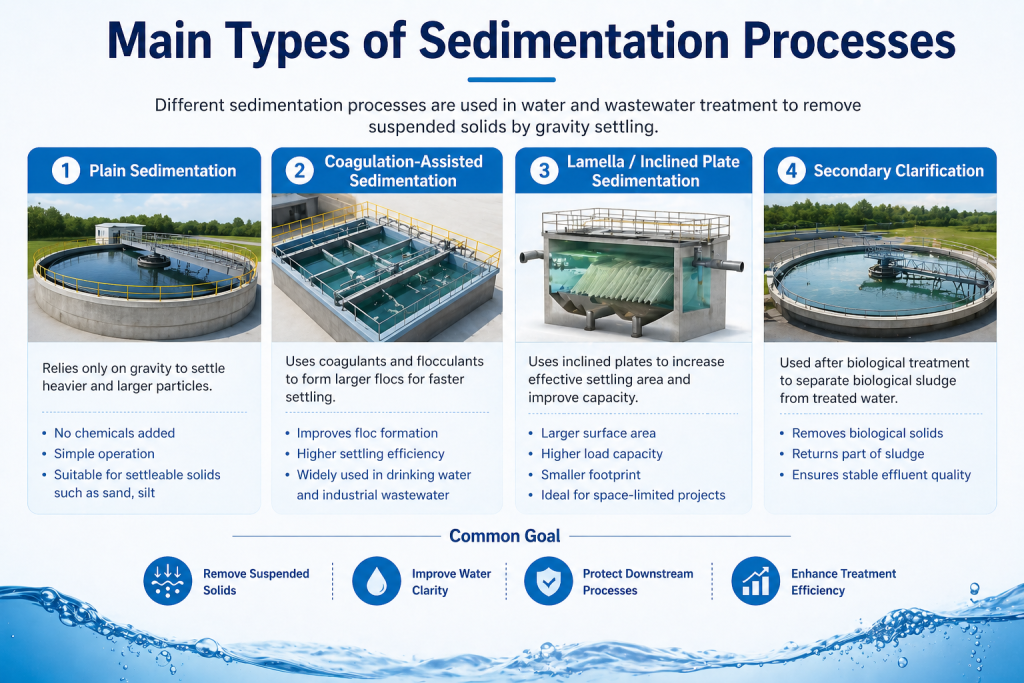
Different water and wastewater conditions require different sedimentation methods. The main types include plain sedimentation, coagulation-assisted sedimentation, lamella sedimentation, and secondary clarification.
Plain Sedimentation
Plain sedimentation relies only on gravity. No chemicals are added. It is suitable for removing larger and heavier particles such as sand, silt, and settleable solids.
However, plain sedimentation is less effective for fine particles, colloids, and low-density suspended solids.
Coagulation-Assisted Sedimentation
Coagulation-assisted sedimentation uses coagulants and flocculants to improve particle settling. Small suspended particles are destabilized and combined into larger flocs, which settle more quickly.
This method is widely used in drinking water treatment, industrial wastewater treatment, and high-turbidity water treatment.
Lamella Sedimentation
Lamella sedimentation, also known as inclined plate sedimentation, uses inclined plates or tubes to increase the effective settling area. Compared with traditional sedimentation tanks, lamella clarifiers can achieve higher treatment capacity with a smaller footprint.
This method is suitable for projects with limited space or wastewater with high suspended solids.
Secondary Clarification
Secondary clarification is mainly used in biological wastewater treatment systems. It separates activated sludge from treated effluent and helps maintain the stability of the biological process.
A well-operated secondary clarifier is essential for preventing sludge washout and maintaining good effluent quality.
What Can Sedimentation Remove?
Sedimentation mainly removes pollutants that exist as suspended or settleable solids. It is effective for many physical pollutants but not suitable for dissolved pollutants.
| Removed by Sedimentation | Description |
| Suspended solids | Particles floating or dispersed in water |
| Sand and silt | Heavier inorganic solids |
| Flocs | Larger particles formed after coagulation and flocculation |
| Biological sludge | Activated sludge from biological treatment |
| Precipitated metals | Metals converted into insoluble forms |
| Turbidity-causing particles | Fine solids that affect water clarity |
| Some organic matter | Organic solids attached to suspended particles |
Table of Sedimentation Remove
However, sedimentation cannot effectively remove dissolved salts, dissolved organic chemicals, many pathogens, ammonia, nitrate, or micropollutants. These pollutants usually require filtration, biological treatment, membrane separation, adsorption, ion exchange, disinfection, or advanced oxidation.
Factors Affecting Sedimentation Efficiency
Sedimentation performance depends on both water quality and engineering design. If any key factor is not properly controlled, the final effluent may still contain high suspended solids or turbidity.
Particle Size and Density
Larger and heavier particles settle faster. Fine particles and colloids settle slowly and often require coagulation or flocculation.
Flow Velocity
If the water flow is too fast, particles do not have enough time to settle. Excessive turbulence can also break flocs and carry settled solids into the outlet.
Hydraulic Retention Time
Hydraulic retention time refers to how long water stays in the sedimentation tank. A longer retention time usually improves settling, but it also requires a larger tank volume.
Surface Overflow Rate
Surface overflow rate is an important design parameter for sedimentation tanks. If the overflow rate is too high, solids may be washed out before settling.
Chemical Dosing
In coagulation-assisted sedimentation, coagulant and flocculant dosing directly affects floc formation. Incorrect dosing may cause poor settling, floating sludge, or excessive chemical consumption.
Sludge Removal
Settled sludge must be removed regularly. If sludge stays too long in the tank, it may become anaerobic, float upward, or affect effluent quality.
Tank Design
Inlet distribution, outlet weir design, baffles, tank depth, sludge hopper design, and scraper systems all influence sedimentation performance.
Sedimentation vs Filtration
| Comparison | Sedimentation | Filtration |
| Main principle | Gravity settling | Physical interception through filter media |
| Target pollutants | Heavier suspended solids and flocs | Fine particles remaining after sedimentation |
| Energy demand | Usually low | Depends on pressure and filter type |
| Position in process | Before filtration | After sedimentation or clarification |
| Main purpose | Reduce solids load | Improve final water clarity |
Table of Sedimentation vs Filtration
How to improve sedimentation performance?
- To improve sedimentation efficiency, operators should focus on both process control and equipment configuration.
- First, the influent flow should be stable. Sudden hydraulic shocks can disturb settled sludge and cause solids washout.
- Second, coagulation and flocculation should be optimized when fine particles are difficult to settle. Proper chemical dosing can greatly improve floc size and settling speed.
- Third, sludge should be discharged regularly. Excessive sludge accumulation reduces effective tank volume and may cause sludge rising.
- Fourth, online monitoring should be used when stable operation is required. Turbidity meters, flow meters, pH meters, and sludge blanket level meters can help operators understand system performance in real time.
- Finally, the sedimentation tank or clarifier should be selected according to wastewater characteristics, flow rate, footprint, suspended solids concentration, and downstream treatment requirements.
GL Solution
The sedimentation process is one of the most important physical separation steps in water and wastewater treatment. It removes suspended solids by gravity, improves water clarity, reduces the load on downstream treatment units, and supports the stable operation of filtration, biological treatment, disinfection, and sludge handling systems.
GL Environment is committed to providing practical and reliable water treatment solutions for different industries. If you are planning a sedimentation, clarification, or wastewater pretreatment project, please contact us for customized process design and equipment selection.