What is ZLD?
ZLD is a strategic wastewater management system designed to eliminate all liquid waste discharge within a facility’s boundaries. Through recycling and recovery processes, it converts wastewater into reusable fresh water and dry solid residue.
Why Will ZLD Become Indispensable in 2026?
In 2026, Zero Liquid Discharge (ZLD) is becoming an essential solution for industrial wastewater treatment due to increasing water scarcity, stricter environmental regulations, and growing demand for water reuse. Industries are gradually shifting from traditional wastewater discharge models to closed-loop water recycling systems.
For industries such as power plants, textiles, chemicals, mining, and semiconductors, freshwater resources are becoming more limited and expensive. ZLD systems can recover and reuse up to 95–99% of wastewater, helping reduce water consumption and improve water sustainability.
At the same time, governments worldwide are enforcing stricter discharge standards and environmental policies. ZLD helps industries minimize liquid waste, reduce pollution risks, and support long-term environmental compliance.
With the development of advanced RO membranes, evaporation systems, automation, and online monitoring technologies, modern ZLD systems are becoming more efficient and practical. As a result, ZLD is evolving from a high-end wastewater treatment technology into a key part of future industrial water management.
ZLD Technology
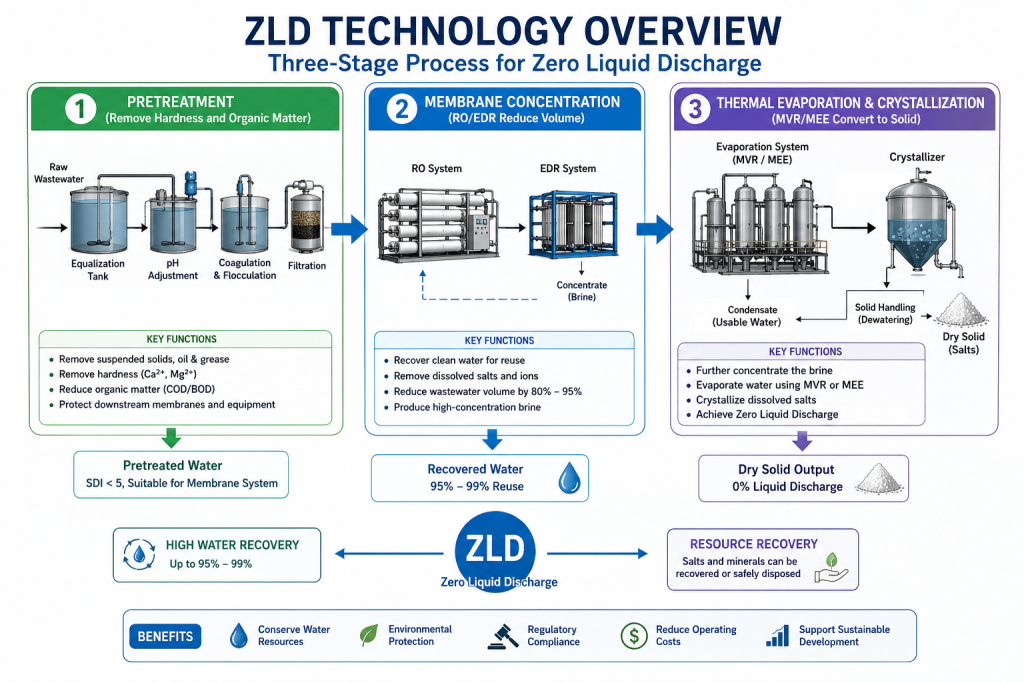
Pretreatment
This is the most critical preliminary step, designed to remove suspended solids, calcium and magnesium ions (hardness), and organic matter (COD) from the wastewater, thereby preventing scaling and fouling in the subsequent membrane system.
- Clarifier or High-Efficiency Sedimentation Tank: Used to settle large suspended solids.
- Multi-media Filter or Ultrafiltration (UF): Removes fine particles and colloids.
Chemical Treatment Equipment:
Dosing System: Adds sodium hydroxide, sodium carbonate, or flocculants for water softening and scale removal.
Sludge Treatment Equipment:
Screw Press: Dewaters sludge generated from sedimentation.
Filter Press: Used to achieve higher solids content in sludge dewatering.
Membrane Concentration
By using physical retention methods, the wastewater is concentrated as much as possible to produce a small amount of highly concentrated brine while recovering the majority of high-quality freshwater, thereby significantly reducing the volume of water entering the subsequent, costly thermal treatment stage.
- Reverse Osmosis (RO) Systems: The most commonly used concentration method, including Seawater Reverse Osmosis (SWRO) or Disc Tube Reverse Osmosis (DTRO).
- Electrodialysis (ED): Utilizes an electric field to drive ions through a selective membrane; suitable for treating brine with a high tendency to form scale.
Thermal Evaporation and Crystallization Stage
Evaporation Equipment:
- MVR Evaporator (Mechanical Vapor Recompression): This system uses a compressor to pressurize secondary vapor, offering extremely high energy efficiency and representing the current mainstream choice.
- MEE Multi-Effect Evaporator: This system utilizes multiple evaporators connected in series and is suitable for plants with abundant waste heat resources.
Crystallization and Drying Equipment:
Forced-Circulation Crystallizer: Facilitates the precipitation of salt from a saturated solution.
- Centrifuge: Separates the crystallized salt from the mother liquor.
- Rotary Sludge Dryer: If a drier final product is required, further drying can be performed.
Digital Monitoring and Operations and Maintenance
Modern ZLD plants are transitioning toward “digitalization” and “unmanned operation.
| Technology Type | Typical Energy Consumption (kWh/m³) | Energy Efficiency | Key Driving Factor |
|---|---|---|---|
| High-Recovery RO | 5–12 | >20% | Feed Water Salinity |
| Brine Concentrator (MVR) | 20–30 | 10–15% | Compressor Efficiency |
| Thermal Crystallizer | 50–70 | <10% | Salt Solubility |
Table of ZLD plants
Summary
Zero Liquid Discharge (ZLD) is becoming one of the most important solutions for modern industrial wastewater treatment. By combining pretreatment, membrane concentration, evaporation, and crystallization technologies, ZLD systems can maximize water recovery while minimizing environmental discharge.
Contact GL environment for customized hard water treatment solutions.